Radiation Aspects and Performance of Geo-polymerized Zeolite Concrete
Keywords:
Zeolite, Radiation, Geopolymer, Alkaline, Sodium hydroxide, Activators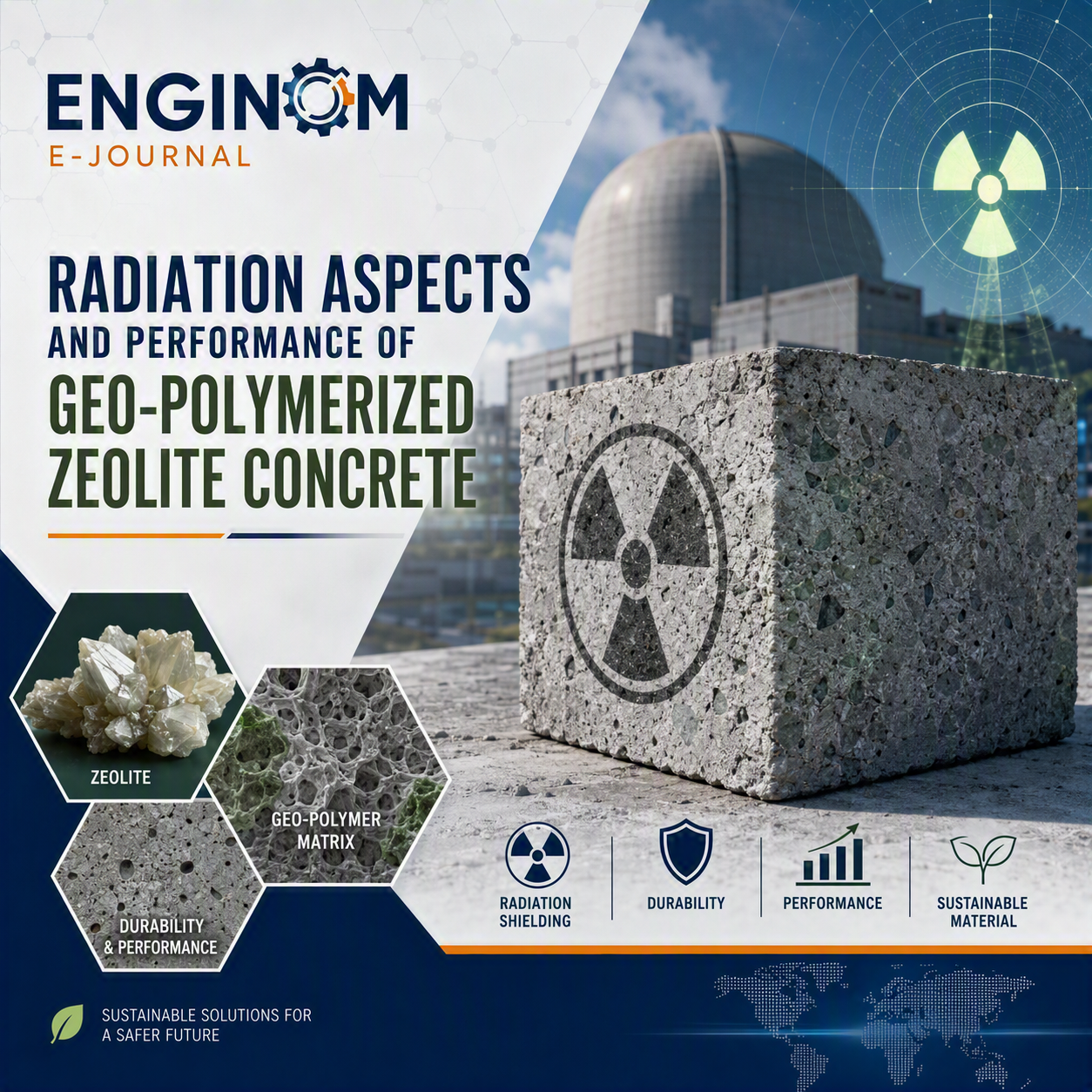
A series of concrete mixtures was prepared by substituting cement with zeolite at replacement levels of 0, 25, 50, 75 and 100 wt%. The study examined the mechanical properties, corrosion behavior of embedded steel reinforcement, and various nuclear radiation attenuation parameters for five concrete mixes. Corrosion performance was assessed through multiple electrochemical methods and optical microscopy. Furthermore, three neutron energy levels and nine gamma-ray energy lines (ranging from 121.78 to 1407.92 keV) were employed to determine the macroscopic neutron cross-sections (Σ, cm⁻¹) and the mass attenuation coefficients (σ, cm²/g) for gamma rays within the concrete speci-mens. The findings indicated that both the mechanical strength of the concrete and the corrosion resistance of the embedded steel improved with the addition of zeolite up to 50 wt.%. For the mass attenuation coefficients corresponding to most of the investigated gamma-ray energies, the optimal zeolite content was found to be 50 wt.%.
[1] A. Mohsen, M. Kohail, A. A. Abadel, Y. R. Alharbi, M. L. Nehdi, and M. Ramadan, “Correlation between porous structure analysis, mechanical efficiency and gamma-ray attenuation power for hydrothermally treated slag-glass waste-based geopolymer,” Case Stud. Constr. Mater., vol. 17, p. e01505, 2022, doi: https://doi.org/10.1016/j.cscm.2022.e01505. DOI: https://doi.org/10.1016/j.cscm.2022.e01505
[2] Y. Zhou, X. Chen, Y. Zhan, S. Wang, and J. Xu, “Review of the transmittance effects and long-term radiation mechanisms of γ on heavy concrete,” Prog. Nucl. Energy, vol. 175, p. 105353, 2024, doi: https://doi.org/10.1016/j.pnucene.2024.105353. DOI: https://doi.org/10.1016/j.pnucene.2024.105353
[3] R. Devi, Poonamjot, M. Singh, and A. Sharma, “Efficacy of advanced concretes for attenuation of ionizing radiations: A comprehensive review and comparison,” Prog. Nucl. Energy, vol. 178, p. 105502, 2025, doi: https://doi.org/10.1016/j.pnucene.2024.105502. DOI: https://doi.org/10.1016/j.pnucene.2024.105502
[4] K. Kishore, A. Pandey, N. K. Wagri, A. Saxena, J. Patel, and A. Al-Fakih, “Technological challenges in nanoparticle-modified geopolymer concrete: A comprehensive review on nanomaterial dispersion, characterization techniques and its mechanical properties,” Case Stud. Constr. Mater., vol. 19, p. e02265, 2023, doi: https://doi.org/10.1016/j.cscm.2023.e02265. DOI: https://doi.org/10.1016/j.cscm.2023.e02265
[5] D. Jóźwiak-Niedźwiedzka, P. Rovnaník, M. Dąbrowski, J. Ośko, M. Kuć, and M. Maciak, “Gamma radiation attenuation, mechanical properties and microstructure of barite-modified cement and geopolymer mortars,” Nucl. Eng. Technol., vol. 57, no. 4, p. 103295, 2025, doi: https://doi.org/10.1016/j.net.2024.10.057. DOI: https://doi.org/10.1016/j.net.2024.10.057
[6] J. Adrien, H. Elsayed, F. Gobbin, A. Italiano, E. Maire, and P. Colombo, “X-ray computed tomography investigation on the geopolymer matrix formation during the binder jetting additive manufacturing process,” Addit. Manuf., vol. 109, p. 104852, 2025, doi: https://doi.org/10.1016/j.addma.2025.104852. DOI: https://doi.org/10.1016/j.addma.2025.104852
[7] S. M. U. Toprak, R. Polat, A. Levet, and Ş. N. Toprak, “Effect of stone color, dosage and alkali type on Ahlat Stone (volcanic origin) based geopolymer concretes,” J. Build. Eng., vol. 67, p. 106059, 2023, doi: https://doi.org/10.1016/j.jobe.2023.106059. DOI: https://doi.org/10.1016/j.jobe.2023.106059
[8] R. Sharma et al., “Simultaneous use of bismuth trioxide and mill scale for ternary blended geopolymer composite in radiation shielding applications,” Prog. Nucl. Energy, vol. 172, p. 105213, 2024, doi: https://doi.org/10.1016/j.pnucene.2024.105213. DOI: https://doi.org/10.1016/j.pnucene.2024.105213
[9] H. Ş. Arel, E. Aydin, and S. D. Kore, “Ageing management and life extension of concrete in nuclear power plants,” Powder Technol., vol. 321, pp. 390–408, 2017, doi: https://doi.org/10.1016/j.powtec.2017.08.053. DOI: https://doi.org/10.1016/j.powtec.2017.08.053
[10] A. Öz et al., “The radiation shielding and microstructure properties of quartzic and metakaolin based geopolymer concrete,” Constr. Build. Mater., vol. 342, p. 127923, 2022, doi: https://doi.org/10.1016/j.conbuildmat.2022.127923. DOI: https://doi.org/10.1016/j.conbuildmat.2022.127923
[11] B. Kanagaraj, N. Anand, A. Diana Andrushia, and M. Z. Naser, “Recent developments of radiation shielding concrete in nuclear and radioactive waste storage facilities – A state of the art review,” Constr. Build. Mater., vol. 404, p. 133260, 2023, doi: https://doi.org/10.1016/j.conbuildmat.2023.133260. DOI: https://doi.org/10.1016/j.conbuildmat.2023.133260
[12] S. Dwibedy, S. K. Parhi, S. Panda, and S. K. Panigrahi, “Performance of precursor characteristics in the realisation of geopolymer concrete: a review,” Mag. Concr. Res., vol. 76, no. 24, pp. 1404–1423, 2024, doi: https://doi.org/10.1680/jmacr.24.00120. DOI: https://doi.org/10.1680/jmacr.24.00120
[13] E. Mukiza et al., “Effect of gamma radiation on early age strength and pore structure development of metakaolin-based geopolymer used for conditioning cesium and strontium radioactive waste,” J. Nucl. Mater., vol. 614, p. 155912, 2025, doi: https://doi.org/10.1016/j.jnucmat.2025.155912. DOI: https://doi.org/10.1016/j.jnucmat.2025.155912
[14] X. Ge, Y. Liu, Y. Mao, X. Hu, and C. Shi, “Characteristics of fly ash-based geopolymer concrete in the field for 4 years,” Constr. Build. Mater., vol. 382, p. 131222, 2023, doi: https://doi.org/10.1016/j.conbuildmat.2023.131222. DOI: https://doi.org/10.1016/j.conbuildmat.2023.131222
[15] D. Shi et al., “Recycling E-waste CRT glass in sustainable geopolymer concrete for radiation shielding applications,” J. Environ. Chem. Eng., vol. 12, no. 6, p. 114693, 2024, doi: https://doi.org/10.1016/j.jece.2024.114693. DOI: https://doi.org/10.1016/j.jece.2024.114693
[16] M. A. Mahrous, M. A. Abdelghany, A. C. C. Trindade, M. Aboukhatwa, W. M. Kriven, and I. M. Jasiuk, “Investigating irradiation effects on metakaolin-based geopolymer,” Constr. Build. Mater., vol. 437, p. 136837, 2024, doi: https://doi.org/10.1016/j.conbuildmat.2024.136837. DOI: https://doi.org/10.1016/j.conbuildmat.2024.136837

Downloads
Published
Issue
Section
License
Copyright (c) 2026 ENGINOM in Engineering Innovations

This work is licensed under a Creative Commons Attribution 4.0 International License.
How to Cite





 LinkedIn
  Google Scholar
  Academia