Investigations on the Behavior of Alum-slag and Albite Based Geopolymer Mortar in Relation to the Type of Alkaline Solution
Keywords:
Aluminum slag, Pozzolanic activity, Geopolymer mortar, Alkaline- Activators, Alkali-aggregate reaction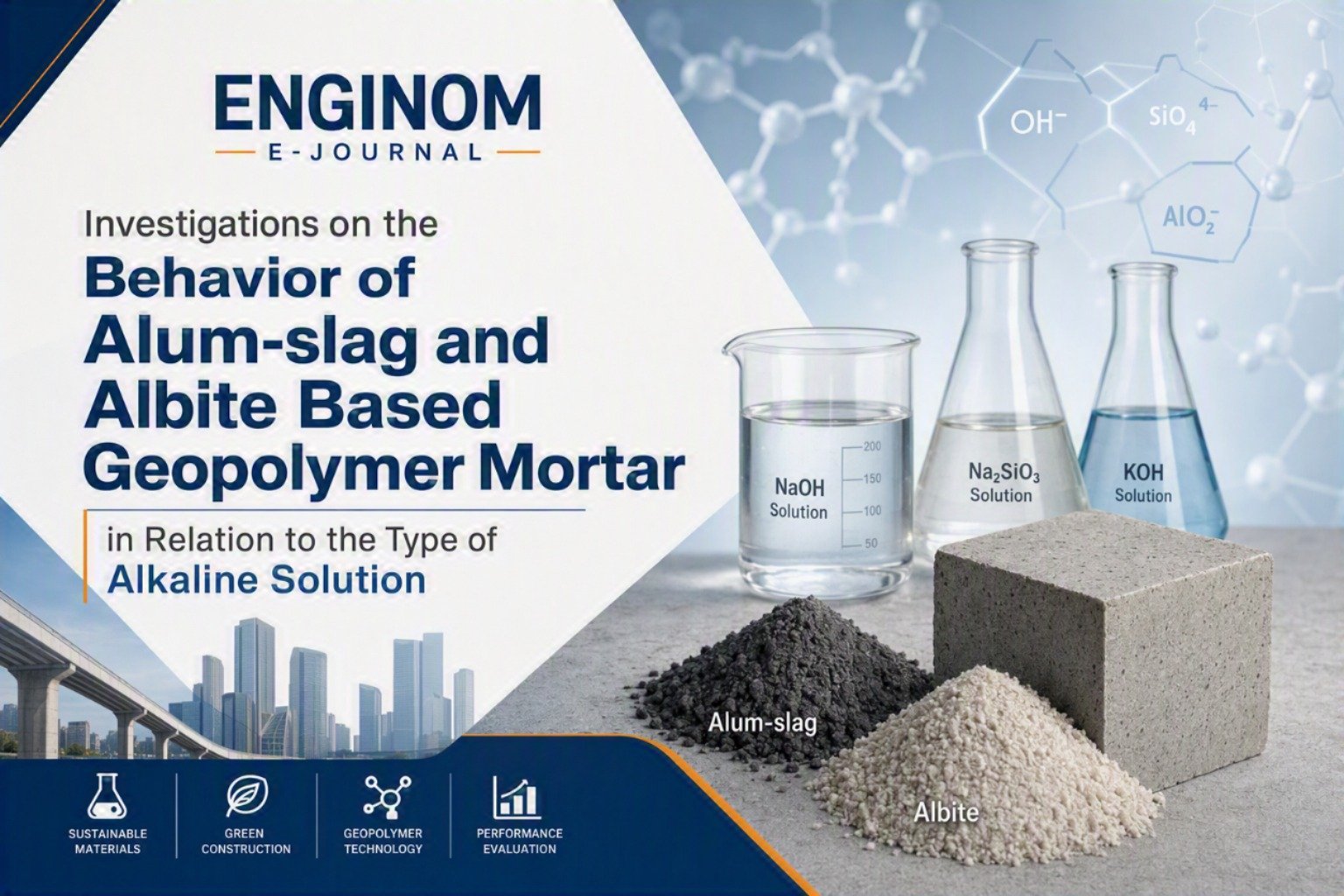
An experimental investigation on the efficient use of Albite and red mud (aluminum slag) in geopolymer mortar is presented in this publication. For varying mix proportions, alka-line activators based on sodium were combined with sodium meta silicate (Na2SiO3). The Na2SiO3/NaOH ratio and the molarity of the NaOH solution served as the study's parame-ters. Three concentrations of NaOH (8, 12, and 16 molars) were examined. The findings demonstrated that the factors under investigation had a major impact on the characteris-tics of the geopolymer mortars that were created. The accelerated mortar bar test (AMBT), workability, setting time, and pozzolanic activity were examined and reported.
[1] B. Walkley, X. Ke, O. H. Hussein, S. A. Bernal, and J. L. Provis, “Incorporation of strontium and calcium in geopolymer gels,” J. Hazard. Mater., vol. 382, p. 121015, 2020, doi: https://doi.org/10.1016/j.jhazmat.2019.121015.
[2] X. Huang, Y. Tian, J. Jiang, X. Lu, Z. He, and K. Jia, “Mechanical properties and enhancement mechanism of iron ore tailings as aggregate for manufacturing ultra-high performance geopolymer concrete,” Constr. Build. Mater., vol. 439, p. 137362, 2024, doi: https://doi.org/10.1016/j.conbuildmat.2024.137362.
[3] S. Jain, N. Banthia, and T. Troczynski, “Leaching of immobilized cesium from NaOH-activated fly ash-based geopolymers,” Cem. Concr. Compos., vol. 133, p. 104679, 2022, doi: https://doi.org/10.1016/j.cemconcomp.2022.104679.
[4] X. Zhang et al., “Porous geopolymer composites: A review,” Compos. Part A Appl. Sci. Manuf., vol. 150, p. 106629, 2021, doi: https://doi.org/10.1016/j.compositesa.2021.106629.
[5] S. K. John, Y. Nadir, and K. Girija, “Effect of source materials, additives on the mechanical properties and durability of fly ash and fly ash-slag geopolymer mortar: A review,” Constr. Build. Mater., vol. 280, p. 122443, 2021, doi: 10.1016/j.conbuildmat.2021.122443.
[6] K. Chen, D. Wu, M. Yi, Q. Cai, and Z. Zhang, “Mechanical and durability properties of metakaolin blended with slag geopolymer mortars used for pavement repair,” Constr. Build. Mater., vol. 281, p. 122566, 2021, doi: 10.1016/j.conbuildmat.2021.122566.
[7] J. Matsimbe, M. Dinka, D. Olukanni, and I. Musonda, “Performance evaluation and mix design of ambient-cured fly ash-phosphogypsum blended geopolymer paste and mortar,” Results Eng., vol. 24, p. 103280, 2024, doi: https://doi.org/10.1016/j.rineng.2024.103280.
[8] A. El Abd et al., “Neutron imaging of moisture transport, water absorption characteristics and strength properties for fly ash/slag blended geopolymer mortars: Effect of drying temperature,” Constr. Build. Mater., vol. 449, p. 138436, 2024, doi: https://doi.org/10.1016/j.conbuildmat.2024.138436.
[9] M. Shaaban, W. F. Edris, E. Odah, M. S. Ezz, and A. A. A. Al-sayed, “A Green Way of Producing High Strength Concrete Utilizing Recycled Concrete,” vol. 9, no. 10, 2023.
[10] A. A. K. A. Al Sayed, Q. F. Al-Waked, S. M. M. Shawky, H. M. Al-jabali, and W. Fouad Edris, “Effect of alkali activated limestone-silica fume blended precursor on performance enhancement of recycled aggregate concrete,” Case Stud. Constr. Mater., vol. 19, no. September, p. e02661, 2023, doi: 10.1016/j.cscm.2023.e02661.
[11] J. Davidovits, “Properties of Geopolymer Cements,” First Int. Conf. Alkaline Cem. Concr., pp. 131–149, 1994.
[12] J. Hwalla, H. El-Hassan, A. El-Mir, J. J. Assaad, and T. El-Maaddawy, “Development of geopolymer and cement-based shotcrete mortar: Impact of mix design parameters and spraying process,” Constr. Build. Mater., vol. 449, p. 138457, 2024, doi: https://doi.org/10.1016/j.conbuildmat.2024.138457.
[13] A. M. Rashad, G. M. F. Essa, W. M. Morsi, and E. A. Fahmy, “Calcium nitrate as a modifier agent for metakaolin-based geopolymer mortar,” Constr. Build. Mater., vol. 456, p. 139199, 2024, doi: https://doi.org/10.1016/j.conbuildmat.2024.139199.
[14] H. A. A. E. Ghanim, U. J. Alenagram, N. M. Bunnori, and M. S. I. Ibrahim, “Innovative In-House Sodium Silicate Derived from Coal Bottom Ash and Its Impact on Geopolymer Mortar,” J. Build. Eng., p. 111428, 2024, doi: https://doi.org/10.1016/j.jobe.2024.111428.
[15] Y. Chen, C. Zou, J. S. Yeo, J. Lin, T. H. Tan, and K. H. Mo, “Valorization of high-volume crushed waste glass as fine aggregate in foamed geopolymer,” Case Stud. Constr. Mater., vol. 22, p. e04202, 2025, doi: https://doi.org/10.1016/j.cscm.2025.e04202.
[16] T. Bezabih, D. Sinkhonde, and D. Mirindi, “Revisiting the surface characteristics of fly ash-teff straw ash-based geopolymer mortars in the context of fractal theory,” Results in Surfaces and Interfaces, vol. 17, p. 100292, 2024, doi: https://doi.org/10.1016/j.rsurfi.2024.100292.
[17] C. K. Madheswaran, P. S. Ambily, J. K. Dattatreya, and G. Ramesh, “Experimental Studies on Behaviour of Reinforced Geopolymer Concrete Beams Subjected to Monotonic Static Loading,” J. Inst. Eng. Ser. A, vol. 96, no. 2, pp. 139–149, 2015, doi: 10.1007/s40030-015-0115-1.
[18] S. Lekshmi, J. Sudhakumar, and S. Thomas, “Application of clay in geopolymer system: A state-of-the-art review,” Mater. Today Proc., 2023, doi: https://doi.org/10.1016/j.matpr.2023.04.083.
[19] S. S. Chanda and S. Guchhait, “A comprehensive review on the factors influencing engineering characteristics of lightweight geopolymer concrete,” J. Build. Eng., vol. 86, p. 108887, 2024, doi: https://doi.org/10.1016/j.jobe.2024.108887.
[20] S. Chowdhury, S. Mohapatra, A. Gaur, G. Dwivedi, and A. Soni, “Study of various properties of geopolymer concrete - A review,” Mater. Today Proc., vol. 46, no. xxxx, pp. 5687–5695, 2020, doi: 10.1016/j.matpr.2020.09.835.
[21] T. Udhaya Kumar and M. Vinod Kumar, “Investigation on mechanical properties of geopolymer aggregate concrete,” Mater. Today Proc., vol. 43, no. xxxx, pp. 1220–1225, 2020, doi: 10.1016/j.matpr.2020.08.758.
[22] T. Bezabih, D. Sinkhonde, and D. Mirindi, “On the surface roughness properties of fly ash-based geopolymer mortars with teff straw ash from the image analysis viewpoint,” Green Technol. Sustain., vol. 3, no. 1, p. 100127, 2025, doi: https://doi.org/10.1016/j.grets.2024.100127.
[23] S. Madhusudhana, J. N. Prakash, and L. H. Manjunath, “Study on preparation and mechanical characterization of alluminium-albite composites using powder metallurgy technique,” Mater. Today Proc., vol. 54, pp. 390–394, 2022, doi: https://doi.org/10.1016/j.matpr.2021.09.456.
[24] G. A. Khater, A. A. El-Kheshen, M. M. Farag, H. Shendy, and N. H. S. Nasralla, “Preparation and characterization of low-cost albite and wollastonite glass-ceramics based on natural raw materials,” Next Mater., vol. 9, p. 101183, 2025, doi: https://doi.org/10.1016/j.nxmate.2025.101183.
[25] X. Zheng, C. Zhang, H. Ma, H. Yang, Y. Zhao, and B. Liu, “Effect of albite on shrinkage and carbonation resistance of alkali-activated slag,” Constr. Build. Mater., vol. 409, p. 134141, 2023, doi: https://doi.org/10.1016/j.conbuildmat.2023.134141.
[26] S. Lawanwadeekul, P. Chindaprasirt, N. Ariyajinno, A. Srisuwan, and N. Phonphuak, “Acid-resistant clay bricks incorporating bottom ash and waste glass strengthened by mullite suppression and albite formation,” Next Mater., vol. 11, p. 101610, 2026, doi: https://doi.org/10.1016/j.nxmate.2026.101610.
[27] N. B. Singh and B. Middendorf, “Geopolymers as an alternative to Portland cement: An overview,” Constr. Build. Mater., vol. 237, pp. 1–15, 2020, doi: 10.1016/j.conbuildmat.2019.117455.
[28] S. Chowdhury, S. Mohapatra, A. Gaur, G. Dwivedi, and A. Soni, “Study of various properties of geopolymer concrete - A review,” Mater. Today Proc., vol. 46, no. July 2024, pp. 5687–5695, 2020, doi: 10.1016/j.matpr.2020.09.835.
[29] W. Huang and H. Wang, “Formulation development of metakaolin geopolymer with good workability for strength improvement and shrinkage reduction,” J. Clean. Prod., vol. 434, p. 140431, 2024, doi: https://doi.org/10.1016/j.jclepro.2023.140431.
[30] S. S. Rahman and M. J. Khattak, “Feasibility of Reclaimed Asphalt Pavement Geopolymer Concrete as a Pavement Construction Material,” Int. J. Pavement Res. Technol., vol. 16, no. 4, pp. 888–907, 2023, doi: 10.1007/s42947-022-00169-8.
[31] M. Cabinets, M. Rooms, B. Statements, and T. Method, “ASTM C1260 Standard test method for potential alkali reactivity of aggregates (mortar_bar method), ASTM International, West Conshohocken, PA,” pp. 12–16, 2014.
[32] B. Poletanovic, K. Kopecsko, and I. Merta, “Fibre hornification improves the long-term properties of hemp fibre-reinforced fly ash-based geopolymer mortar,” Constr. Build. Mater., vol. 446, p. 137957, 2024, doi: https://doi.org/10.1016/j.conbuildmat.2024.137957.
[33] P. W. Ariyadasa, A. C. Manalo, W. Lokuge, V. Aravinthan, K. Pasupathy, and A. Gerdes, “Bond performance of fly ash-based geopolymer mortar in simulated concrete sewer substrate,” Constr. Build. Mater., vol. 446, p. 137927, 2024, doi: https://doi.org/10.1016/j.conbuildmat.2024.137927.
[34] M. S. Khan, M. Ismail, X. Chen, and R. Ahmad, “Novel upcycling of aluminum electrolysis waste into high value albite (NaAlSi3O8) ceramic material for UV reflective coatings,” J. Alloys Compd., vol. 1062, p. 187568, 2026, doi: https://doi.org/10.1016/j.jallcom.2026.187568.
[35] Y. Sun, S. Liu, Q. Wen, J. Guo, and Z. Yang, “Experimental and DFT simulation studies on the mechanism of acid and alkali promoted dissolution of albite,” Appl. Surf. Sci., vol. 641, p. 158475, 2023, doi: https://doi.org/10.1016/j.apsusc.2023.158475.
[36] A. Rezzoug, N. Leklou, K. Ayed, and H. Maryam, “Enhancing geopolymer mortars for environmental sustainability: A novel approach using frits and ceramic waste,” Next Res., vol. 1, no. 2, p. 100024, 2024, doi: https://doi.org/10.1016/j.nexres.2024.100024.
[37] A. Rezzoug, K. Ayed, and N. Leklou, “Thermal, mechanical and microstructural properties of geopolymer mortars derived from ceramic sanitary-ware wastes: Pathway to net zero emission,” Ceram. Int., 2024, doi: https://doi.org/10.1016/j.ceramint.2024.10.414.
[38] C. Ag-, B. Statements, and W. Pycnometer, “Standard Test Method for iTeh Standards iTeh Standards,” pp. 22–25, 2015, doi: 10.1520/C1038.
[39] ASTM, “ASTM C230 Standard Specification for Flow Table for Use in Tests of Hydraulic Cement,” Annu. B. ASTM Stand., pp. 4–9, 2010.
[40] A. Hassani and F. Kazemian, “Investigating geopolymer mortar incorporating industrial waste using response surface methodology: A sustainable approach for construction materials,” Case Stud. Constr. Mater., vol. 21, p. e03609, 2024, doi: https://doi.org/10.1016/j.cscm.2024.e03609.

Downloads
Published
Issue
Section
License
Copyright (c) 2026 ENGINOM in Engineering Innovations

This work is licensed under a Creative Commons Attribution 4.0 International License.
How to Cite





 LinkedIn
  Google Scholar
  Academia